
Understanding What You’re Experiencing
Recognition can be a useful first step.
You do not need to know exactly what is wrong, have a diagnosis, or know what kind of support you need before you begin.
Sometimes the first step is simply noticing what has changed — how much capacity you have, what is taking more effort than it used to, what keeps repeating, or where your system may be asking for more support.
This page offers information and reflection tools to help you better understand what you may be experiencing and consider what kind of next step might fit.
Where Are You Right Now?
The Surviving Scale is a simple reflection tool for noticing how much capacity you have available right now.
It is not a diagnosis and it is not a measure of how well you are doing. It can help you notice whether most of your energy is going toward getting through the day, maintaining what is already on your plate, rebuilding capacity, or having enough reserve to engage more fully in life.
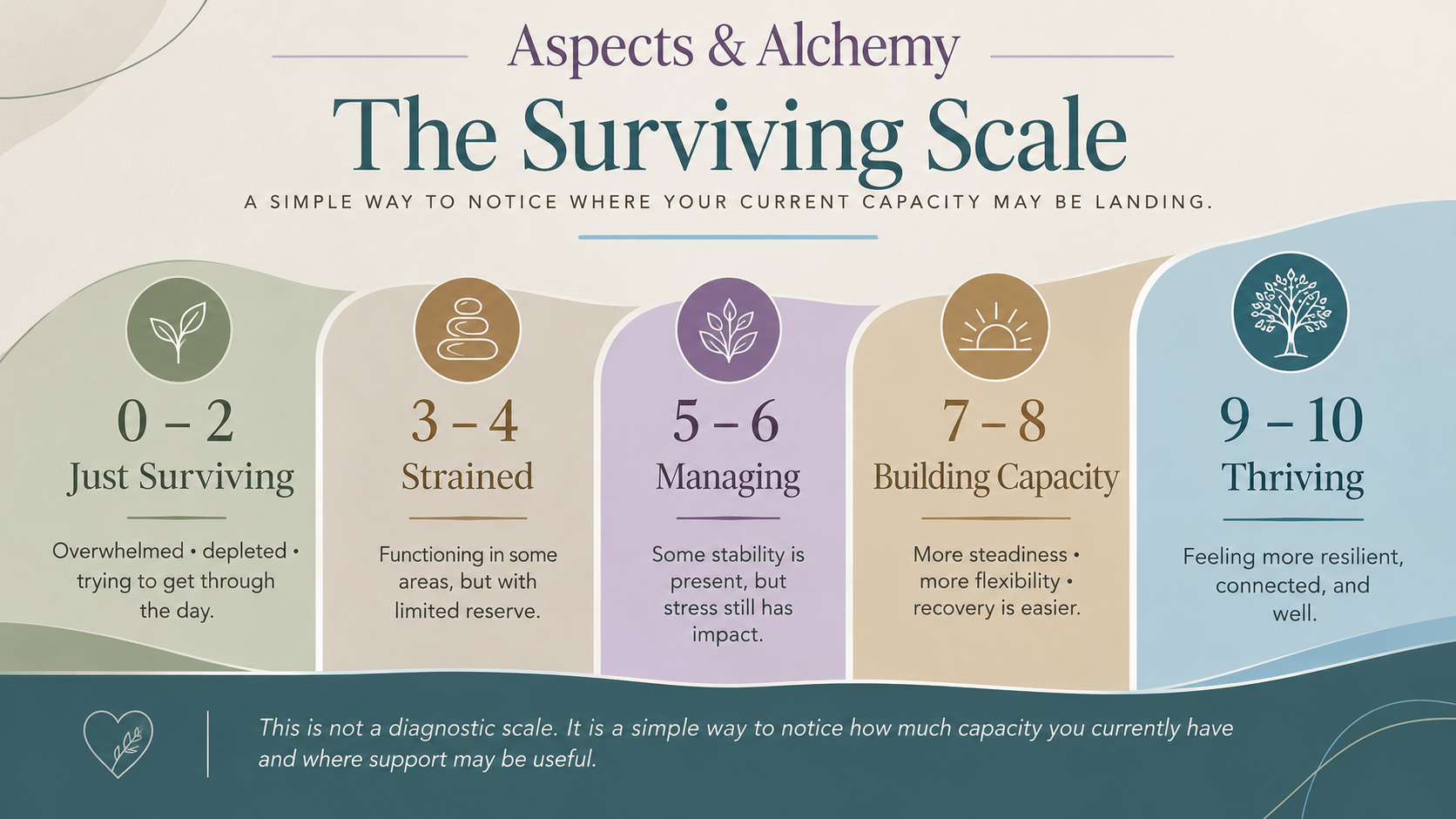
Where you land may shift from day to day, across different areas of life, or as circumstances change.
Functioning Is Not the Same as Capacity
You can still be working, caring for others, meeting obligations, keeping appointments, and appearing capable while using most of your available capacity to do it.
Functioning tells us what you are still able to carry.
Capacity tells us how much it is costing you to carry it, how much reserve remains, and how easily your system can recover when more is added.
Being able to keep going does not always mean you have enough reserve.
What This Can Look Like
Stress, anxiety, depression, grief, trauma responses, exhaustion, and loss of direction do not always look the way people expect.
Sometimes the signs are obvious.
Sometimes they show up as irritability, withdrawal, overfunctioning, sleep disruption, difficulty concentrating, feeling disconnected, or simply noticing that everyday life is taking more effort than it used to.
These experiences can overlap, and similar patterns can have very different causes.
The goal here is not to diagnose, but to help you recognize what may deserve attention.
Depression
Depression can involve sadness, but it can also look like exhaustion, disconnection, reduced motivation, loss of interest, changes in sleep or appetite, difficulty concentrating, hopelessness, or feeling that even ordinary tasks require too much effort.
Some people continue functioning while feeling increasingly depleted underneath. Others may withdraw, stop doing things they once enjoyed, or lose a sense of purpose or connection.
What matters is not whether your experience matches a particular picture of depression, but whether something has changed and is affecting your ability to live, connect, recover, or engage with what matters to you.
Chronic Stress & Overwhelm
Stress is part of life, but sustained stress can gradually use more of the capacity you normally rely on to think clearly, regulate emotions, recover, connect with others, and manage everyday demands.
You may still be getting everything done while becoming increasingly tired, irritable, forgetful, reactive, disconnected, or unable to recover between demands.
Overwhelm is not always about how much you are carrying. It can also reflect how much capacity is available to carry it.
Shutdown, Numbness & Disconnection
Not every stress response feels intense. Sometimes the system moves in the opposite direction — toward numbness, withdrawal, exhaustion, reduced emotion, difficulty thinking, or feeling disconnected from yourself or the people around you.
You may know something matters but struggle to feel connected to it. You may want to act but find it difficult to begin, or need much more time and space than usual to respond.
Slowing down and rebuilding capacity may be more useful than trying to force yourself back into functioning.
Sleep & Exhaustion
Sleep and energy can be affected by stress, anxiety, grief, physical health, changing routines, persistent activation, or simply carrying too much for too long.
You may have difficulty falling asleep, wake frequently, sleep for long periods without feeling restored, or find that your energy disappears much earlier than it once did.
Exhaustion can also reduce the capacity available for emotional regulation, concentration, connection, and recovery. Sleep concerns may have physical or medical causes as well, so appropriate healthcare assessment remains important when needed.
Anxiety
Anxiety can show up as worry, racing thoughts, physical tension, restlessness, difficulty concentrating, sleep disruption, avoidance, panic, or a persistent sense that something needs your attention.
Sometimes anxiety is obvious. Other times it can look like overthinking, overpreparing, needing certainty, staying constantly busy, or finding it difficult to fully settle even when nothing immediate is wrong.
Rather than asking only how to make anxiety disappear, it can be useful to notice what your system is responding to and what may help it experience more safety, capacity, and choice.
Trauma & Protective Responses
Protective responses can develop when your system has learned that something requires increased safety, vigilance, distance, control, appeasement, escape, or shutdown.
They may appear as fight, flight, freeze, withdrawal, people-pleasing, hypervigilance, difficulty with boundaries, emotional numbness, or patterns that seem to activate before you consciously understand why.
These responses are not proof that something is wrong with you. They may be ways your system learned to protect you. Understanding them can create more choice about what is still needed now.
Grief & Loss
Grief can follow a death, but loss can take many forms — relationships, health, identity, roles, family changes, opportunities, places, expectations, or a future you thought you would have.
It may come in waves and can include sadness, anger, relief, numbness, longing, exhaustion, confusion, or moments of feeling completely normal.
There is no single correct way to grieve. Support can help create room for what has been lost while also making space for what continues and what may come next.
Loss of Meaning or Direction
Sometimes what feels wrong is difficult to name because life may still look functional from the outside.
Changes in relationships, work, caregiving, health, identity, retirement, major transitions, or simply outgrowing an earlier version of your life can leave you unsure of what comes next.
Loss of direction does not always mean something needs to be fixed. Sometimes it means there is space to reconnect with what matters, what fits now, and what you want to move toward.
Sometimes the Question Is Not Only “What Symptoms Do I Have?”
Symptoms can tell us that something needs attention, but they do not always tell us where the strain is coming from.
Aspects & Alchemy looks across the whole person — Body, Mind, Heart, Spirit, and Expression — to notice where capacity may be running low, where something may need support, and where there may already be strengths to build from.
BODY
Sleep
Rest
Physical comfort
Movement
Health
Energy
MIND
Focus
Clarity
Worry
Mental load
Patterns
Expectations
HEART
Connection
Belonging
Grief
Emotional support
Relationships
SPIRIT
Meaning
Direction
Hope
Values
Purpose
EXPRESSION
Voice
Creativity
Movement
Identity
Communication
Expressing what is happening
When Support May Be Useful
You do not have to wait until things become unmanageable before seeking support.
Support may be useful when:
everyday demands are taking more effort than they used to
your usual coping strategies are no longer enough
stress, anxiety, grief, exhaustion, or emotional strain are affecting daily life
you keep finding yourself in the same patterns
you are functioning, but have very little reserve left
you feel disconnected from yourself, other people, or what matters to you
you know something needs attention but are not sure where to begin
Sometimes the first useful step is simply creating enough space to understand what is happening.
When Another Level of Care Is Needed
Aspects & Alchemy is trauma-informed and clinically adjacent. It is not diagnosis, psychotherapy, medical treatment, crisis care, or emergency support.
Some concerns require medical, psychological, psychiatric, crisis, or other specialized care. When that is the more appropriate level of support, referral or collaboration is part of responsible practice.
Needing another type of care does not mean this work has failed or that you have done something wrong. It means the support needs to match what is happening.
Questions People Often Have
You do not need to understand every part of the process before reaching out. These are some of the questions people commonly have before beginning.
-
You do not need to choose the right pathway before reaching out.
We begin with where you are, what is happening, what you would like support with, and what level of work your system can comfortably sustain. The session type can then be selected or adapted based on your goals, capacity, readiness, and support plan.Description text goes here
-
No.
All sessions use some level of relaxation, regulation, grounding, or focused attention as a starting point, but they do not all involve hypnosis or deeper trance work.
Some sessions remain conversational, somatic, reflective, expressive, or skills-based. Others may move into light co-orientation, guided inner focus, or deeper hypnosis when that is appropriate, consented to, and within your capacity.
The level of relaxation and depth is guided by comfort, consent, readiness, and what your system can sustain.scription text goes here
-
No.
Hypnosis is a collaborative state of focused attention and increased receptivity. You remain able to communicate, make choices, move, open your eyes, pause, or stop at any time.
You are not required to accept suggestions that do not feel right for you.
-
Rapid Transformational Therapy® is one deeper integrative pathway available within Aspects & Alchemy.
It is used selectively rather than automatically and is not treated as a first step for every client. It is generally considered when there is enough regulation, stability, capacity, and readiness to support deeper work and integration afterward.
-
You can pause, stop, redirect, sit up, open your eyes, move, speak, or change the pace at any time.
Consent is ongoing. The session does not continue simply because something was planned in advance.
The work moves at the pace your system can sustain.
-
No.
Diana Marie Wellness Solutions does not provide psychotherapy, diagnosis, medical treatment, crisis care, or emergency services.
The work is trauma-informed, clinically adjacent, body-led, and focused on capacity, recognition, integration, and sustainable change.
When another type or level of care is more appropriate, referral or collaboration is part of responsible practice.
-
You can begin with the Individual Inquiry form.
You do not need to know exactly what is happening, have the right words, or know which service you need before reaching out. The first step is simply helping me understand where you are beginning and what kind of support may fit.
You Do Not Need to Have It All Figured Out
You do not need the right words, a diagnosis, or a complete explanation of what is happening.
You can begin with what you notice now.
From there, we can look at what is asking for attention, what capacity is available, and what kind of next step may fit.
First we listen. Then we stabilise. Then we explore what is ready. Then we integrate. Then we live it forward.